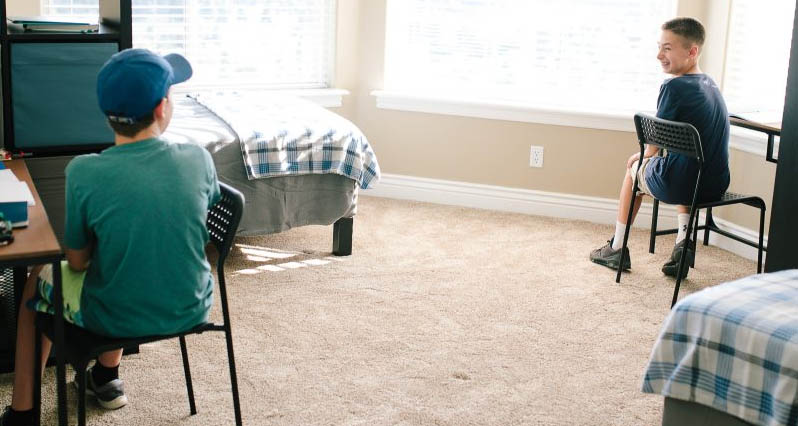
Watching your teenager struggle is one of the hardest parts of parenting a child with autism. This can be academically, emotionally, or socially. Have you already tried outpatient therapy or school accommodations? When that support isn’t enough, many families start researching an autism boarding school as the next step.
This guide walks through what these programs offer. You’ll learn how to evaluate them, and what questions to ask. This is a good step before choosing one for your family.
Looking for an autism boarding school for your teen? New Focus Academy isn’t a traditional boarding school. Instead, it’s a residential treatment center in Heber City, Utah, combining accredited academics with therapy and life skills training for neurodiverse teens. Talk with our admissions team to see if it’s the right fit for your family.
Small Class Sizes
Building academic confidence and relationship skills
An autism boarding school is a residential program. It’s for teens on the autism spectrum who need more structured, full-time support. That’s compared to typical school or weekly therapy sessions. Students live on campus, usually for several months to over a year. This is while receiving academics, clinical therapy, and daily life-skills coaching in one integrated setting.
Unlike other boarding schools, these programs are built around neurodivergent learning styles. Staff are trained in autism support. The daily schedule helps to reduce overwhelm while still challenging students to grow. The goal isn’t just to “manage” behavior. Instead, it’s to help teens build the skills and confidence they need to live independently.
Autism Programs for Teens: What to Look For
Not every program with “autism support” offers the same level of care. When you’re comparing autism boarding schools for teens, there are many factors to consider.
Personalized Treatment Plans. Every student’s needs are different. Look for programs that build goals around each teen’s strengths and challenges. That’s rather than a one-size-fits-all curriculum.
Evidence-Based Clinical Support. Ask what therapeutic models the program uses and how they measure progress.
Small Student-to-Staff Ratios. Teens with autism may do better in smaller, close-knit communities where they aren’t lost in a crowd.
Integrated Academics. Look for accredited schooling that adapts to different learning styles. That’s rather than a rigid, one-track classroom.
Life Skills, Not Just Talk Therapy. Strong programs teach real-world skills. This can include cooking, budgeting, social interaction, and self-advocacy. That’s alongside clinical treatment.
Family Involvement. Programs that include parents in the process can produce more lasting results. That’s rather than treating the teen in isolation.
Does the program clearly explain how it personalizes treatment? If not, that’s a red flag worth taking seriously.
Boarding Schools for Teens with Autism vs. Traditional Schools
It’s worth being honest about traditional school settings. Even with an IEP or 504 plan, it may not be enough for teens who are struggling.
Traditional schools are built around a fixed schedule. There’s often a large student body and limited one-on-one support. This can be challenging for teens managing sensory sensitivities, social anxiety, or executive functioning challenges. That environment can be exhausting rather than supportive. Even the best-intentioned teachers and counselors are stretched across students with different needs.
Boarding schools for teens with autism flip that structure. Academics are just one part of a fully integrated day. Programs can include therapy, coaching, and supervised social practice. Students aren’t expected to “hold it together” for six hours. They don’t have to figure out life skills on their own at home. Instead, everything happens in one supportive environment. There’s often staff available around the clock.
This doesn’t mean traditional school is the wrong choice for every family. Many teens thrive with the right accommodations in a mainstream setting. However, anxiety, meltdowns, isolation, or safety concerns may have grown. If so, a residential program offers a level of consistency that’s hard to replicate at home.
Signs Your Teen May Benefit from an Autism Boarding School
Every family’s situation looks different. However, a few patterns tend to show up. A residential program may become worthwhile if:
Outpatient therapy or school-based support hasn’t led to meaningful progress
Increasing social isolation, school refusal, or difficulty maintaining friendships
Escalating anxiety, meltdowns, or emotional dysregulation at home or school
Struggles with basic independent living skills such as hygiene, routines, self-care
Safety concerns, including self-harm or highly impulsive behavior
Family stress reaching a breaking point, with parents feeling out of options
If several of these sound familiar, it’s a sign your teen may need more support. It’s not a reflection of anything you’ve done wrong as a parent.
Autism Boarding Schools in the USA: What Sets Programs Apart
There are autism boarding schools across the country. They vary widely in philosophy, structure, and clinical approach. Some emphasize a more clinical, behaviorally focused model. Others lean into a therapeutic community. There can be an approach that blends academics, coaching, and real-world skill-building.
When comparing autism boarding schools in the USA, look past the marketing language. It may help to ask some of these questions:
What’s the actual staff-to-student ratio, day to day?
How is the academic program structured, and is it accredited?
What clinical licenses do the therapists hold?
How does the program handle a teen’s first few weeks of transition?
What does a typical day and week actually look like?
How does the program prepare students to eventually leave and live independently?
Location matters too. It’s not just for logistics, but because the physical environment shapes daily life. A program set in a calm setting can offer a very different day-to-day experience. It can be different than one in a dense urban campus.
Autism Boarding School Alternative in Utah at New Focus Academy
New Focus Academy is located in Heber City, Utah. It’s a residential autism support center and school for teens ages 12 to 18. It’s for those who are navigating social and functional challenges. The program combines personalized academics, clinical therapy, and daily coaching. This happens in a small, close-knit community setting.
New Focus Academy centers its approach around six core values. This helps students understand the “why” behind expectations so those skills carry over into life after the program. Students work on independence through hands-on experiences. This can include meal planning and budgeting to social skills practice. They’re supported by a coaching team trained to work with neurodivergent teens.
The Utah setting itself plays a role in the program. It can offer an outdoor-oriented, lower-stimulation environment. This can be easier for many autistic teens to regulate in compared to a busier urban campus.
What to Expect: Academics, Therapy & Life Skills
A well-run autism boarding school alternative builds each day around different pillars:
Academics. Personalized education plans adapt coursework to each student’s learning style. They work toward graduation while also introducing vocational and workplace-readiness skills.
Therapy and Coaching. Personal and group therapy sessions target each student’s goals. This is while daily coaching reinforces those skills in real, lived situations. It’s not just in a therapist’s office.
Life Skills. Cooking, laundry, budgeting, personal hygiene, and social interaction are core curriculum. They’re not just afterthoughts. Students can practice these skills daily. This happens with support that’s scaled back as independence grows.
Physical health and recreation often round out the schedule. This can give students healthy outlets and routines. This can support emotional regulation alongside clinical treatment.
AUTISM BOARDING SCHOOL ALTERNATIVES
How to Choose the Right Autism Boarding School or Residential Treatment for Your Family
Choosing a program is one of the biggest decisions a family can make. It’s worth taking seriously. A few practical steps can help:
Make a list of your teen’s challenges and goals. Every program will claim to help. Nonetheless, ask how they’d address your teen’s particular situation.
Ask about outcomes and alumni experiences, not just program philosophy.
Talk to admissions directly and ask detailed questions about staff qualifications, daily structure, and family involvement.
Visit if possible, or ask for a virtual tour if travel isn’t an option.
Understand the cost and payment structure. This should include insurance, private pay, and any financial guidance the program offers.
Trust your instincts. The right program should feel transparent, not high-pressure.
Take your time. A program that’s confident in what it offers will welcome your questions. That’s rather than rushing you toward a decision.
FAQs About Autism Boarding Schools and Residential Treatment
How long do teens typically stay at an autism boarding school?
Length of stay varies by student and program. However, many residential placements run anywhere from several months to a year or more. It depends on personal progress and goals.
Is an autism boarding school covered by insurance?
Coverage varies by provider and plan. Most programs, including New Focus Academy, can help families understand payment options. This can include insurance and private pay.
What ages do autism boarding schools typically serve?
Many programs, including New Focus Academy, focus on adolescents ages 12 to 18. Although, some also offer transition support for young adults.
How is an autism boarding school different from a wilderness therapy program?
Wilderness programs are often shorter-term and outdoor-based. Autism boarding schools offer longer-term residential care. They combine full academics, clinical therapy, and daily life-skills coaching in one setting.
What if my teen has never been away from home before?
Reputable programs build in a structured transition period. They can keep families closely involved, so teens aren’t navigating the adjustment alone.
Are you considering an autism boarding school alternative for teens? Is the right next step for your family? If so, reaching out to a program directly is often the best way to get clear answers. To learn more about our program in Utah, contact us today.